

In Summary:
Germany’s growing security cooperation with Kenya reflects shared interests in counterterrorism and regional stability, but also Germany’s search for reliable partners in East Africa and the wider Horn of Africa.
Kenya works with several international partners to avoid relying on one country, yet foreign funding and technology can influence which security concerns receive attention.
Although German-Kenyan cooperation addresses real security threats, longer-term needs, such as community resilience, risk receiving less attention if funding focuses mainly on hard security matters.
Introduction
“Kenya is our closest partner in the region and a true pillar of stability.” - German Foreign Minister Dr. Johann Wadephul
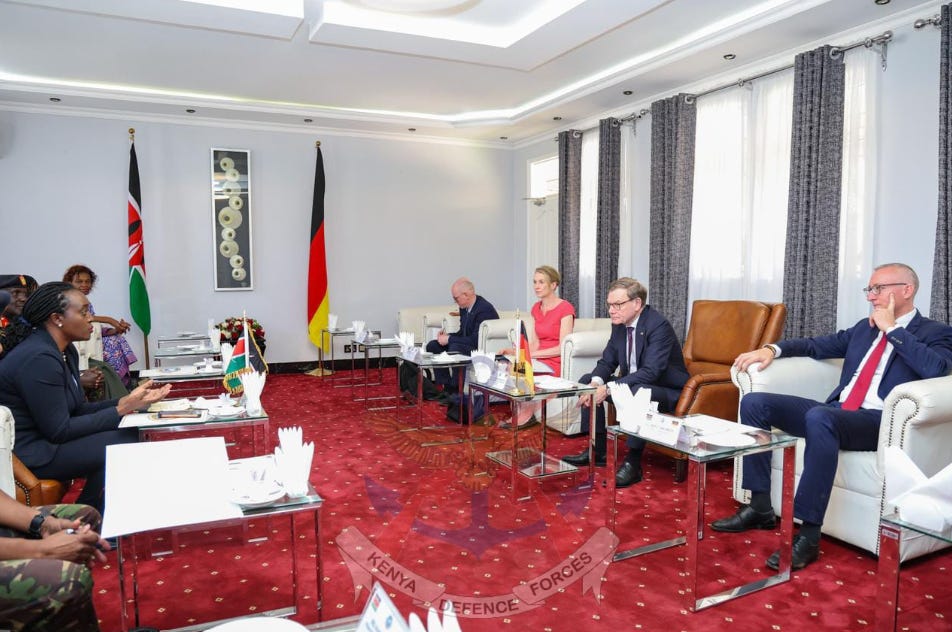
Right before his departure to Kenya in January 2026, German Foreign Minister Dr. Johann Wadephul presented Kenya as a key partner for Germany in East Africa. The following day, upon arrival at the German Embassy in Nairobi, he described Kenya as “a stable and reliable country in a crisis-ridden region” and a key economic partner.
Kenya’s and Germany’s relationship itself is not new. After Kenya gained independence in 1963, West Germany was the first country to officially recognize Kenya under international law. Since then, ties have steadily grown: for instance, more than 100 German companies now operate in Kenya. In 2024, the two governments also agreed on a so-called “Comprehensive Migration and Mobility Partnership,” which covers skilled labour migration and cooperation on repatriation.
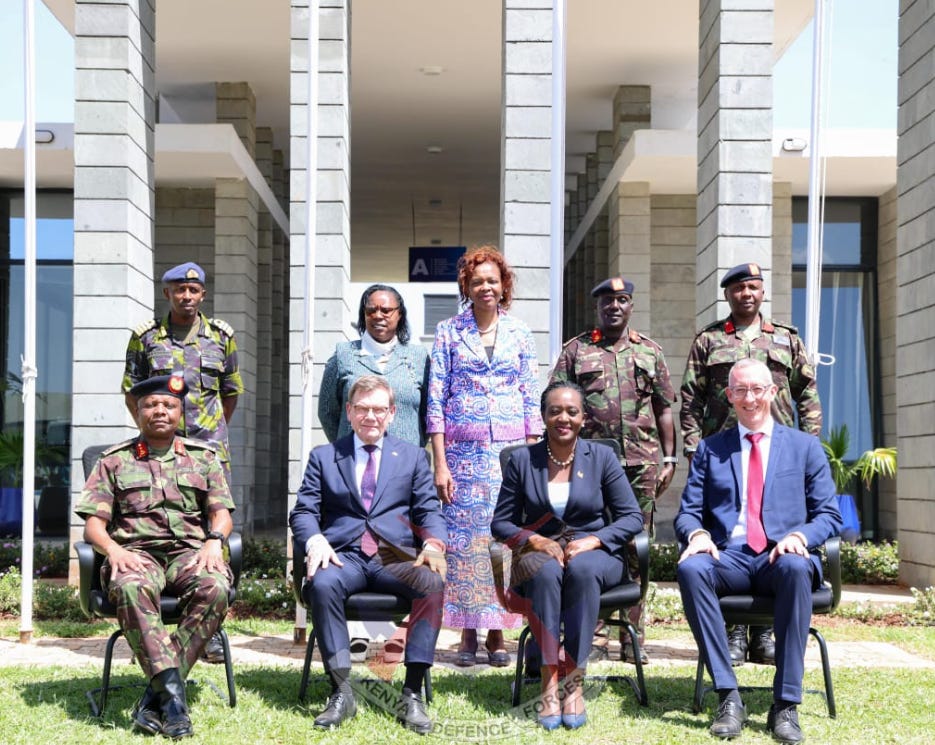
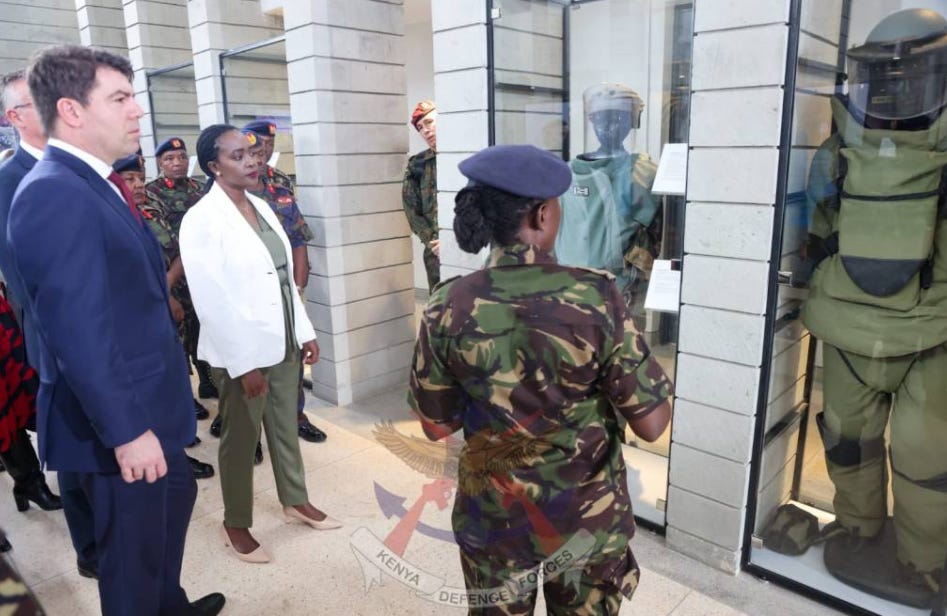
Germany’s 2025 Africa Policy Guidelines identify peace and security as key areas of engagement. Thus, security matters have increasingly moved into the center of cooperation. In Kenya, this means responding to threats such as al-Shabaab attacks and improvised explosive devices (IEDs). The German-funded Counter-IED complex at Nairobi’s Humanitarian Peace Support School, where military, police and civilian personnel receive training, shows one example of that increased cooperation. Kenya’s Ministry of Defence inaugurated the facility on 2 April 2025, and Wadephul visited the complex during his trip to Kenya.
The Counter-IED complex responds to a direct hard security threat. But where a partner chooses to invest also shapes which security concerns get attention. This leads to the following questions:
Who sets the security agenda in German-Kenyan cooperation?
Security Cooperation Takes a More Visible Role
Prof. Dr. Patrick Muthengi Maluki, Institute of Diplomacy and International Studies at the University of Nairobi and chair of Kenya’s Foreign Service Academy Council, describes the move in cooperation towards explicit security matters as a shift in emphasis, not an end to, for instance, development cooperation. He says that “development, climate, economic and governance cooperation remain important (…), yet security itself is now much more explicit in the bilateral vocabulary than before.”
To understand why Germany is interested in security cooperation with Kenya, multiple factors should be considered. Importantly, migration, which often dominates debates on (security) cooperation with African states, does not explain the shift. Dr. Hassan Kannenje, director of the HORN International Institute for Strategic Studies, stresses that “Kenya is not a major source or transit country for irregular migration to Europe (…) Germany’s migration interests instead concern regulated labor mobility and Kenya’s role as a host of large refugee populations.”
Kannenje instead links Germany’s interest to its search for reliable partners following its withdrawal from Mali and setbacks across the Sahel in 2023. As Kenya fits this description, Kannenje points to its role in hosting regional training institutions, contributing to peace support operations in Somalia and taking on international responsibilities such as the Haiti mission.
Germany’s interests also extend beyond security cooperation. “The disruption in the Red Sea and Gulf of Aden has shown Europe how exposed its supply chains are to instability in the wider Horn,” Kannenje notes and adds that Kenya’s own priorities lie elsewhere, such as in “jobs, investment, industrialization and fiscal space. Security cooperation is welcome, but Kenya would like the economic side of the partnership to grow at the same pace.”
The partnership therefore brings together several priorities. Yet, does the increase in security cooperation lead to one-sided dependencies?
Room to Maneuver
Kenya has continued to build security relationships with other countries, not just with Germany alone. As an example, on 28th of January 2026, a Defense Cooperation Agreement with the Czech Republic was signed. Furthermore, in March, 15 partner nations took part in Justified Accord 2026, a multinational military exercise and in June, Kenya and Egypt held their seventh Joint Military Committee meeting. Kannenje sees these ties as an effort to avoid reliance on a single partner and emphasizes that Kenya also works with the United States, the UK and partners across the Gulf, Türkiye and Asia.
This, as Maluki calls it, “portfolio strategy” illustrates ways to diversify international cooperation and to avoid dependence on a single partner, which, in turn, gives Kenya more room to negotiate. However, as Kannenje cautions, “such wider networks do not automatically give the government greater control (…) Agency is not measured by how many partners you have, but by whether those partners are working towards priorities you have defined.”
Similarly, Maluki is careful to jump to quick conclusions. In practice, he explains that partners do not bring equal resources. Wealthier partners bring financing, technology and intelligence capabilities that inevitably create leverage. In Maluki’s words, “diversification may strengthen Kenya’s position, but it cannot, on its own, remove the influence that comes with foreign funding and specialist capabilities.” Thus, without clearly established national priorities, cooperation with multiple partners may instead result in overlapping programmes and competing standards.
Ultimately, more partners may give Kenya more room to maneuver. Yet, the key question is whether it can use them to pursue its own security priorities, rather than accommodating those of its partners.
Which Security Concerns Receive Support?
In July 2026, five Kenyan security personnel were killed in a suspected al-Shabaab ambush in Mandera. That same month, Kenyan troops neutralized four IEDs along supply routes in Lamu. The Global Terrorism Index 2026 identifies al-Shabaab as the fourth-deadliest terrorist organization in 2025. The Counter-IED complex, therefore, addresses real hard security concerns.
Such an urgent need to be addressed, nonetheless, does not alone answer the wider question of how security resources are distributed. “Capacity-building is never entirely neutral (…) where Germany directs its funding matters,” Maluki argues. Germany’s cooperation with Kenya also supports climate resilience, food security and good governance. In December 2022, Germany committed €153 million in new commitments. Its stated priorities include climate and energy, agriculture and sustainable economic development. This broader engagement means that the issue is not simply whether Germany funds hard security or prevention. Rather, it is how different priorities are balanced, which receive sustained support and whether these choices shape Kenya’s wider security agenda.
Kannenje explains further that “hard security, such as the Counter-IED complex, is easier for partners to fund because here, it is visible and runs through state institutions, while prevention and community resilience are slower, harder to measure, and often left to short project cycles.”
Still, although border governance, community resilience and conflict prevention may be harder to measure, this does not make them less important. Such necessities shape how communities experience insecurity and whether security gains can be sustained. If counterterrorism is easier to demonstrate and thus to fund, these longer-term priorities risk receiving less support, despite their importance in addressing the conditions that allow insecurity to persist.
Concluding Remarks
For Maluki “a relationship is not equal if one side pays a disproportionate political price for saying no.” Measured this way, Kannenje sees German-Kenyan security cooperation as closer to equal than many of Kenya’s other security ties. Germany keeps no base and no combat role in Kenya, and its support runs through Kenyan institutions. Still, he calls the cooperation “a partnership of convergent interests with unequal resources (…) with both sides benefiting, while Germany’s financial weight still shapes which forms of cooperation get funded.”
That, in the end, can be the real tension. A wider range of partners gives Kenya more options, yet that does not necessarily mean the same as having control over the agenda. In Kannenje words, “without clear national plans, parliamentary oversight and domestic funding, whoever pays most tends to decide most.” Maluki similarly emphasises that foreign assistance “needs to follow Kenyan and regional priorities, not determine them.” The question is therefore not simply whether German support is useful, but whether it contributes to a broader strategy defined by Kenya itself. The pace of economic cooperation relative to the growing focus on security falls beyond this article’s scope and deserves further attention.