


In Summary:
Riyadh chose escalation after Ansarullah captured Al-Mokha port and the Bab al-Mandeb Strait.
The PLC’s “Yemen Dawn” counteroffensive retook Bab al-Mandeb, but Taiz remains the key obstacle.
Turkey and Pakistan deploy defensively in Saudi Arabia; Syrian and US involvement is uncertain.
Ansarullah targets Saudi oil facilities and airports to wreck the Saudi economy.
Saudi-PLC Activity
The signal for a massive military campaign, aimed at recapturing not only the territory lost in September, was the speech of the PLC leader and Yemeni president Rashad Muhammad al-Alimi. He declared a general counteroffensive on every front under the code name “Yemen Dawn,” with the final goal of capturing Sana’a.
The declaration did not seem to be an empty gesture: PLC units, the Southern Giants Brigades, conducted a ground offensive backed by massive air support of up to 100 aircraft. The operation repelled Ansarullah troops from Bab al-Mandeb and recaptured ground on the western coastline. It was a desperately needed victory, which boosted PLC morale and created hopes of a swift shift in the balance of power. The Saudi Air Force also launched multiple airstrikes targeting Ansarullah troops, command centres, missile launchers, oil facilities, and arms depots, to degrade their military capabilities, blunt their offensive momentum, and demoralize them.
Makkah Pact Allies’ Support
Turkey and Pakistan, members of the nascent Makkah Pact alliance, declared that they will deploy troops in the Saudi Kingdom. Yet both countries publicly stated that their support will be exclusively defensive and strictly confined to Saudi soil, denying any military involvement inside Yemen.
Turkey will assist its Saudi allies with air defence systems, electronic warfare systems, UAVs, intelligence, and advisory support, and a small detachment of Turkish special forces has arrived in the Kingdom. Pakistan, for its part, has already stationed military personnel, aircraft, UAVs, and air defence systems.
Syrian, Egyptian, Emirati, European Involvement and the USA’s Quest
Syrian interim president al-Sharaa has previously denied that he would send Syrian fighters to aid the Saudis in Yemen, yet speculation to the contrary is growing. Riyadh’s pressure on Damascus to send ground forces is also increasing. Riyadh’s funds play a vital role in the reconstruction of Syria, and Damascus is aware of that. Axios reports speak of 20,000 fighters from the 90th and 84th Syrian Army divisions.
Egypt is also affected by the current war. Ansarullah’s military activity in the Red Sea has cost the Egyptian economy $800 million per month. The Egyptian Presidency states that “Egypt will provide Saudi Arabia with all necessary and possible forms of support to defend its security and stability, protect its resources, territorial integrity and Islamic holy site.”
On the other hand, since September the UAE has shown increased activity to restore its relationship with Riyadh, damaged after the December 2025 standoff in Yemen and the UAE’s consequent expulsion. In this direction, Abu Dhabi has decided to re-enter the Yemeni conflict against the Houthis by resuming payments to Yemeni government militias, probably the southern ones.
USA has denied supporting Riyadh with its air force during Ansarullah’s September “blitzkrieg,” providing only intelligence and logistical support. Yet after the recent missile strikes on Riyadh’s airport, the US president insinuated that he may go kinetic in the Yemeni war, though he declined to clarify.
Yet, the two main nuclear European powers, UK and France have also decided to support Saudi Arabia by sending troops, radars, air defense systems, and aircrafts.
The Hazards and Risks for the Saudi Coalition of the Willing
PLC Challenges and Pathologies
The advance of the PLC’s Giants Brigades may have repelled Ansarullah from Bab al-Mandeb, pushed it northwards, and boosted PLC morale, but it has not achieved a decisive victory that would secure these gains. The PLC forces recaptured the Bab al-Mandeb area as well as Dhubab airport, yet Al-Mokha port and the coastal town of Dhubab remain in Ansarullah’s hands. The recently recaptured territories also remain under constant pressure from Ansarullah counteroffensives and missile attacks.
To secure the western coastline, the PLC forces must not only recapture Al-Mokha port but also advance to the outskirts of Hudaydah port city, if not capture it. Such a development would exert immense pressure on Ansarullah, since it would lose the biggest and last port city under its control and be forced to withdraw forces from other fronts to protect the capital, Sana’a.
Moreover, to secure the territorial gains in Bab al-Mandeb, it is also necessary to control the highlands of Taiz governorate, which overlook the whole coastline and can threaten the low-lying coastal terrain, the stationed forces, and the shipping lanes in the Bab al-Mandeb Strait. Yet Taiz city is under tight siege by Ansarullah forces, which has cut the arterial road between Taiz and Aden and captured the surrounding highlands. This blockade will sever the vital supply line between Aden and the interior of the PLC-controlled territories.
Furthermore, the capture of the Taiz highlands and surrounding territories allows Ansarullah to defend the route to Sana’a, threaten Aden , control the low-lying coastal terrain, and menace Marib. Marib is the third-biggest city, hosts the country’s oil facilities, and is a symbol of resistance against Ansarullah. The position of Taiz governorate in the country’s heartlands also allows Ansarullah to manoeuvre its troops more easily along interior lines and deploy faster to any of the three fronts.
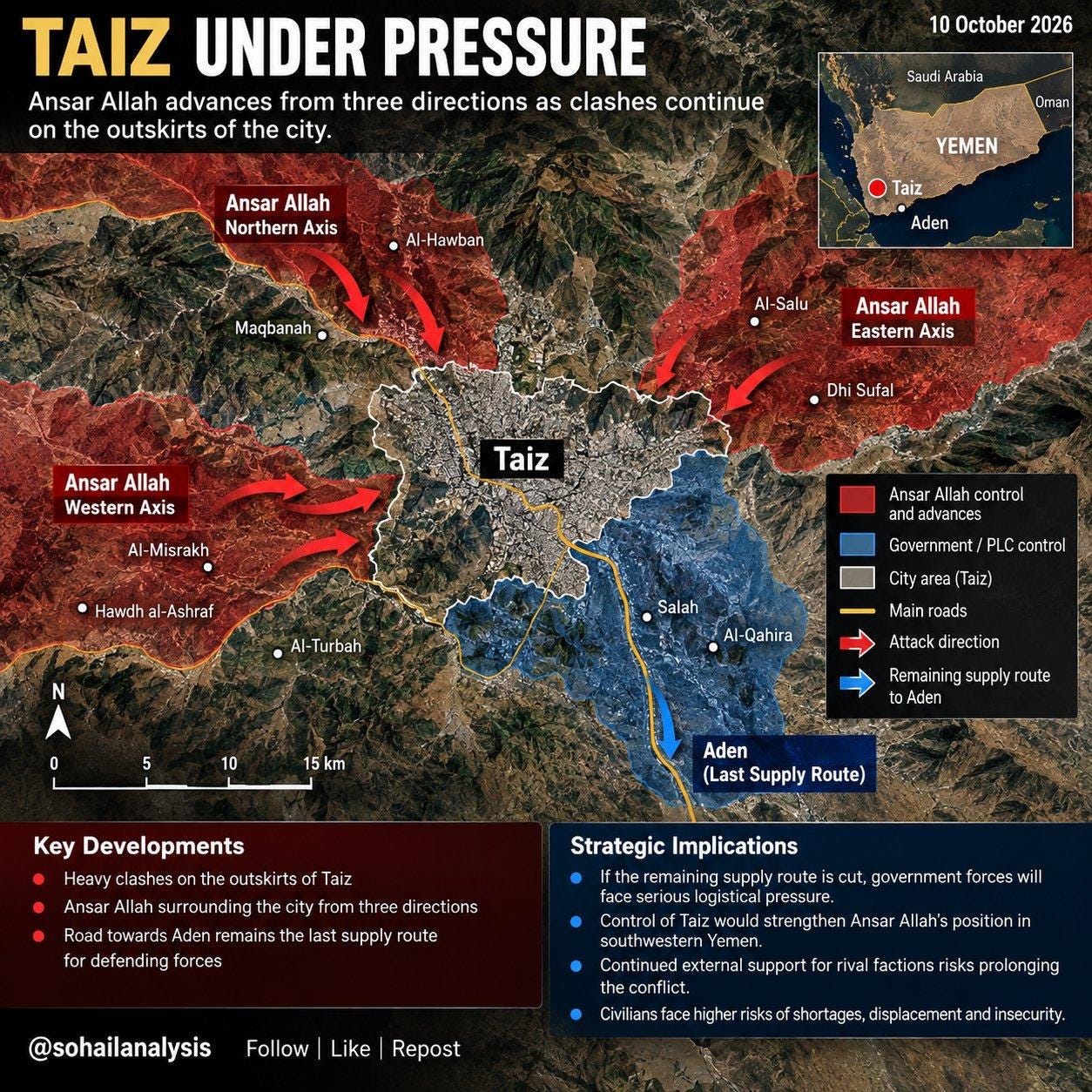
Thus, without dislodging Ansarullah troops from Taiz governorate, it is very difficult to advance on Hudaydah, protect the coastal gains, relieve the pressure on Aden and Marib, secure the supply line to the interior, and launch a ground offensive on Sana’a. Air support from Riyadh and its allies is not sufficient to achieve this. It demands well-prepared, coordinated, multi-front ground operations against a battle-hardened, extensively mobilized, disciplined, highly effective, resilient, and well-entrenched foe with advanced strike capabilities, a cohesive command-and-control structure, and very competent enemy. The incohesive and fragmented PLC forces lack these elements.
That is therefore the big challenge for Riyadh: during a full-scale war with an intensive operational tempo, to transform the PLC into an effective fighting force able to fully exploit its air superiority and its advantages in technology and intelligence. This is an extremely difficult task.
Saudi Economy’s Dire Dilemma
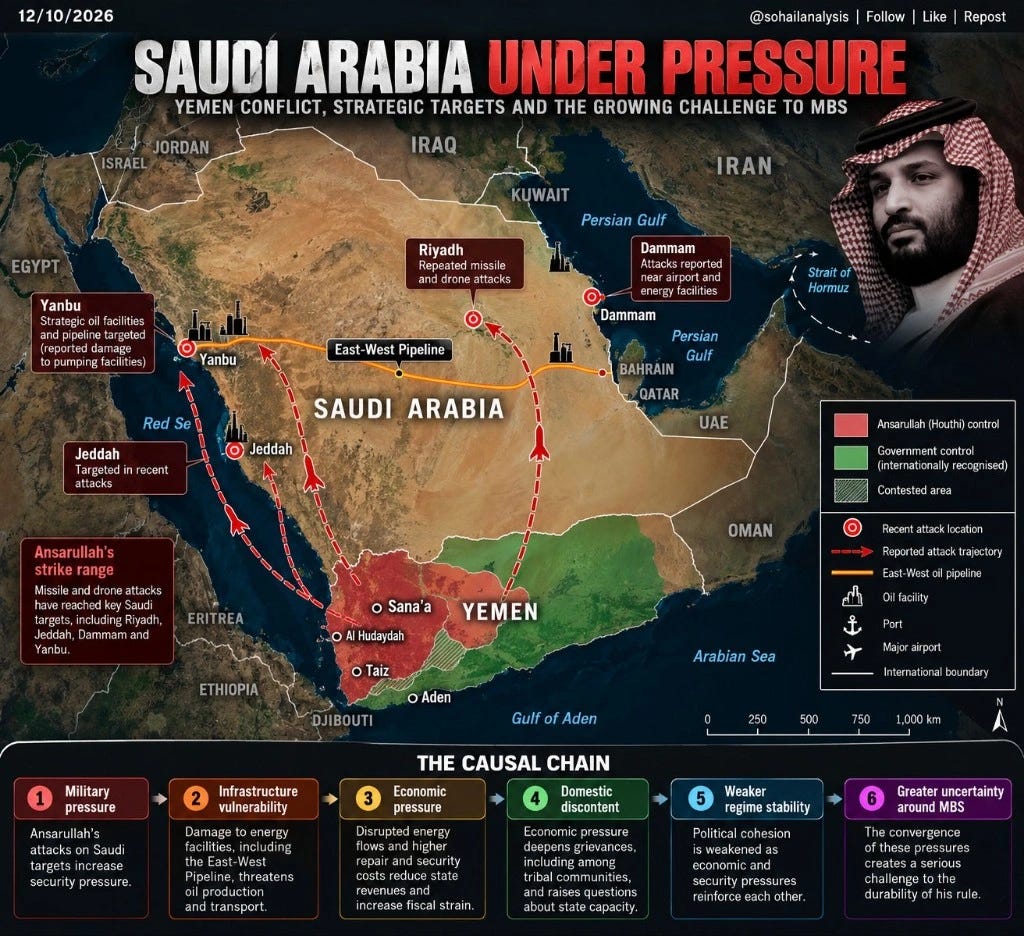
Ansarullah is aware of all the above. Besides conducting intense multi-front operations against the PLC forces, its calculus is to severely hurt the “vital organs” of Saudi Arabia, which are simultaneously the lifeline of the PLC forces. It is targeting the pillars of the Saudi economy with unprecedented intensity, frequency and accuracy. It strikes hydrocarbon facilities (pipelines, terminals, oil and gas fields) mercilessly, aiming to block not only Saudi exports, which are vital for the Kingdom’s survival and for global economic stability, but also production itself. It also bombards Saudi civilian airports and military facilities, causing civilian casualties. Ansarullah’s clear and declared goal is to wreck the Saudi economy by imposing an air and naval blockade while destroying its pillars. The existing air defence shield cannot protect Saudi infrastructure, due to the terrain’s morphology and Ansarullah’s sophisticated tactics. Sana’a is implementing its 16 July threat of airports for airports, ports for ports, and blockade for blockade: a siege against the siege that Riyadh has imposed on Sana’a.
Ansarullah’s anticipated outcomes are threefold. First, to put the Saudi leadership in a dilemma: protect its infrastructure through a political compromise or by pausing air support to the PLC or continue and even intensify its military effort and watch its economy be devastated. Second, to raise the domestic political cost for Riyadh and undermine the legitimacy of the current Saudi leadership, even causing social unrest. Such unrest could turn into a nightmare in the event of an uprising in Saudi Arabia’s Eastern Province, which has a large Shia population as well as oil and gas reserves. Third, to exert pressure on the markets and the already volatile global economy, to press Riyadh into a compromise.
Makkah Pact Members’ Risks
The two new allies of Riyadh risk sinking into the Yemeni quagmire despite their claims of a strictly defensive role on Saudi soil. Even if they do not take part in offensive operations on Yemeni soil, the risk remains high. Ansarullah officials have already stated that Makkah Pact troops stationed in Saudi Arabia are legitimate targets and that vessels linked to Turkish and Pakistani interests will face a blockade in the Red Sea. This will increase the economic cost for their already struggling economies. Furthermore, a scenario of mass Turkish and Pakistani casualties would sharply increase their domestic political cost and put them in the dilemma of whether to halt operations against Ansarullah.
The Ansarullah propaganda machine will also try to spread the narrative that the two most militarily powerful Muslim nations did not send even a bullet to the Palestinian fighters yet are now attacking the only Arab force that dared to attack Israel and support the Palestinian liberation cause. Framing them as members of the American-Zionist axis will be the core of that narrative, which seeks to discredit the role and prestige of Riyadh, Ankara, and Islamabad as protectors of the Ummah and the Holy Sites, while presenting Ansarullah as the Guardian of Islam. The influence of this narrative on the Turkish, Pakistani, and, more generally, Arab and Muslim publics must not be underestimated.
Turkey, however, could face even greater consequences. Ansarullah could try to harm Turkish interests in the Horn of Africa, i.e., Somalia, and strike Ankara’s military assets on land or at sea, either directly (missiles, mines, USVs) or through local partners (al-Shabaab). Turkish troops in Iraq could be targeted by Iraqi militias. Iran is also not expected to limit its support to Yemen. It could harm Turkish interests in Syria by activating pro-Iranian cells and arming dissident Syrian Kurds who oppose Damascus authority. Iran could even form a Machiavellian cooperation with its former archenemies in Syria (ISIS, al-Qaeda, other jihadist groups) who are dissatisfied with al-Sharaa’s rule. The destabilization of Syria, perhaps the biggest Turkish geopolitical achievement since 1922, would pose a very serious security dilemma for Ankara. It would also send a message to al-Sharaa and every Syrian political figure about Tehran’s red lines.
Yet, if Turkish military activity in Yemen intensifies or relations with Tehran deteriorate further, Iranian retaliation could focus on Turkish soil. According to Hashim Tekines, a political analyst at The Institute for Diplomacy and Economy, Iran has several options to retaliate. Among them are targeting the US Incirlik Air Base and the NATO radar in Malatya, and cutting the gas supply to Ankara, which covers 13% of Turkish gas imports. The possibility of sabotage of the Baku-Ceyhan oil pipeline, which carries 600,000 barrels, must also not be ruled out. The pipeline is a lifeline for the Israeli economy and military machine, which makes it an “attractive” target.
The USA Dilemma
The USA has stayed out of Yemen since its unsuccessful 2025 air campaign, while securing impunity for its own commercial fleet. Despite desperate Saudi requests for air support during the September collapse, Washington decided to limit its support to the logistical and intelligence level. The recent devastating strikes on Saudi airports and oil facilities have increased the pressure for American kinetic involvement. That option, however, poses serious problems for the USA.
Sustained US kinetic support through air operations, a naval blockade, and interceptor systems would aggravate its existing shortage of advanced missile stockpiles. It would engage the US Air Force in a struggle with doubtful results, increase the economic cost, and further strain US military personnel already stretched by the war with Iran.
In the scenario of a restart of Iran-USA military operations, with potential Israeli participation, the risks are higher. Reopening is expected to be bloodier and more intense than the previous round, and US forces would be in a dire situation: divided, stretched, and more exposed on two fronts, with insufficient logistical support (advanced missiles). Moreover, the US military presence in East Africa (Djibouti) would also be exposed to Ansarullah’s aerial capabilities.
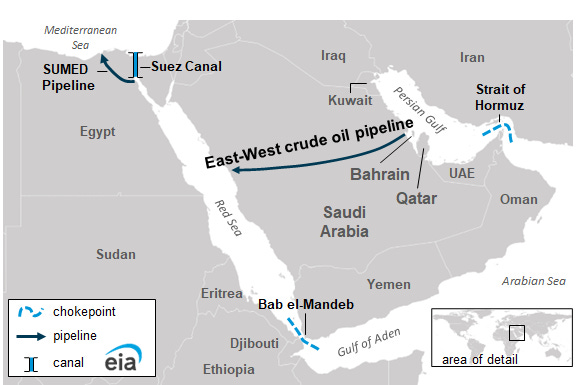
The potential Egyptian involvement awakens nightmares of the past, such as Cairo’s involvement in the North Yemen Civil War (1962–1970), the so-called “Egyptian Vietnam,” with 50,000 casualties. Moreover, although the involvement is declared to be purely defensive and solely on Saudi soil, this does not guarantee that Egyptian forces will not be targeted. Egyptian civilian infrastructure could also be targeted, such as the Sumed Pipeline and the associated energy infrastructure, including terminals and fuel storage facilities. The July drone attack that damaged two oil tankers in the Egyptian port of Damietta is a serious warning about the consequences of the expansion of the war, even though Sanaa has not claimed responsibility. Furthermore, the UAE risks a resumption of Ansarullah attacks on Emirati energy, logistical, and economic infrastructure, which could severely hurt the Emirati economy, without excluding Iranian kinetic action against it.
In addition, although the two European powers are backing Riyadh defensively, both believe that the only feasible solution must be political, not military, and they are very cautious not to challenge Iran.
Conclusion
A regional and international coalition against Ansarullah seems to be formed. However, given the earlier failed air campaigns and the ongoing Russo-Ukrainian and USA-Iran wars, Sana’a can assume that neither the will nor the capability exists for a sustained war against it. Ansarullah should be expected to accept nothing less than the lifting of the Saudi blockade, reparations, and some form of political recognition of its legitimate leading political role in Yemen. Riyadh is caught between the devil and the deep blue sea: it must choose between political defeat and compromise, or military escalation and the destruction of the foundation of its economic survival. Ultimately, the key to shifting the balance of power in Riyadh’s favour is the transformation of the PLC into a cohesive, competent, and coordinated political and military apparatus.