

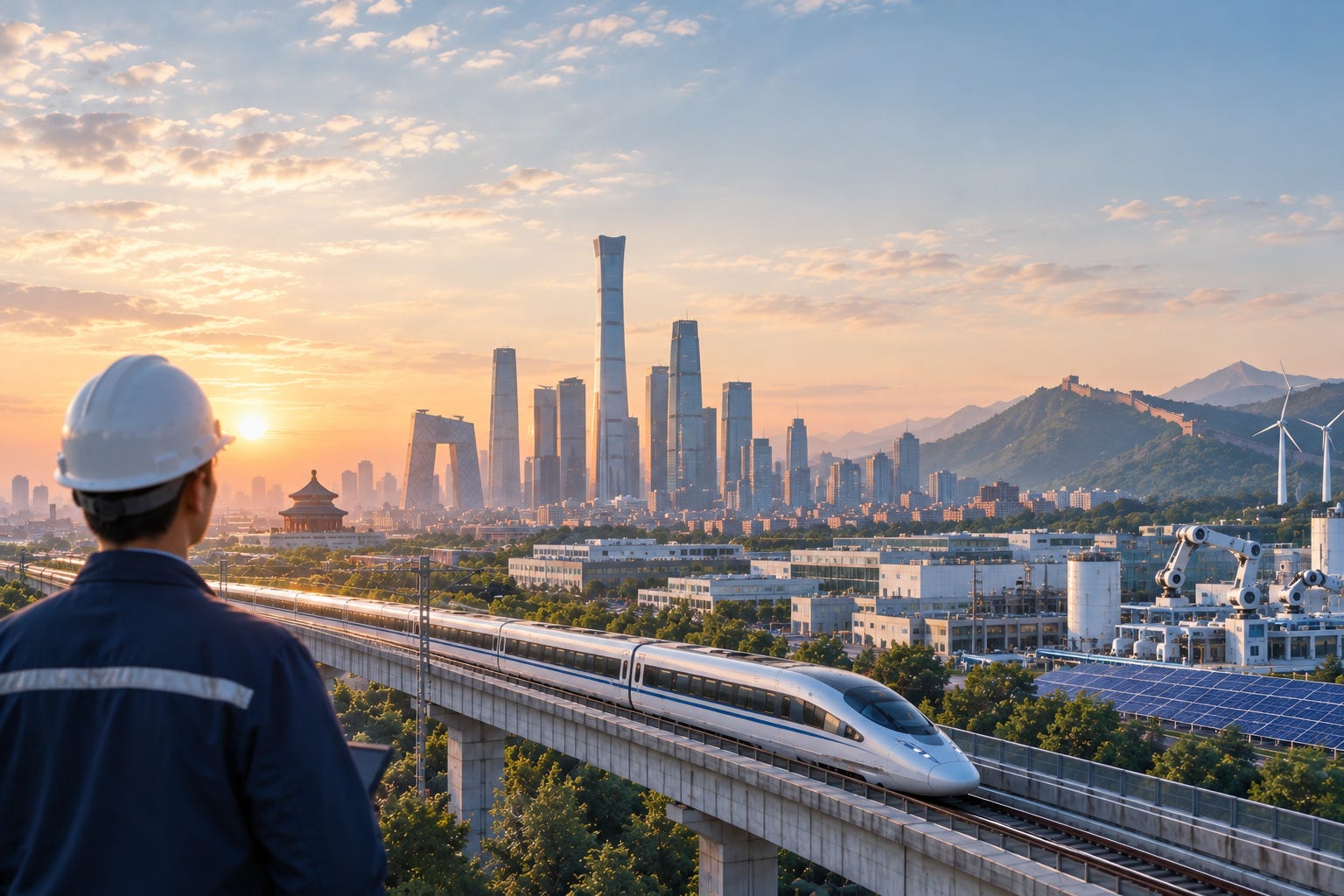
Image: The Hague Institute of Geopolitics (AI generated)
In Summary
The 15th Five-Year Plan consolidates the Party’s strategy for the future of China’s modernization based on sci-tech development
The Party has appointed SOEs as drivers of the “new quality productive forces,” serving government’s interests while bearing economic duties and social responsibilities
By prioritizing production over household consumption, the Chinese state-owned economy exacerbates global trade imbalances, raising concerns over Western deindustrialization and unfair competition
Economic security is a crucial part of Chinese national security, sustaining the Party’s legitimacy through the pursuit of China’s modernization strategy. China’s economic security builds from the goal of self-sufficiency, innovation, security of its supply chain, strategic diversification through export-oriented initiatives to safeguard natural resources. In addition, it heavily relies on and supports State-Owned Enterprises while prohibiting compliance with foreign restrictions against China. Specifically, the role of SOEs outlined in the 15th Five-Year Plan is crucial to understand the future trajectory of China’s economy while recognizing its issues and limitations.
The Next Phase of China’s Modernization
The CCP’s emphasis on economic security is not only to safeguard the country from internal crisis, but also to protect it from external threats, such as wars and sanctions, while at the same time becoming a global leader in key core technologies. As Xi Jinping pointed out, “Chinese modernization must rely on sci-tech modernization for support, and achieving high-quality development must rely on sci-tech innovation to train new drivers of growth” (In Chinese: 中国式现代化要靠科技现代化作支撑,实现高质量发展要靠科技创新培育新动能). The new 15th Five-Year Plan (2026-2030) adopted by the National People’s Congress in March 2026, emphasizes the effects of world conflicts and instability, warning against the escalation of the global power game driven by protectionism, unilateralism and trade fragmentation, which have led to an external hostile environment for China’s modernization. Chinese Premier Li Qiang noted that “the 15th Five-Year Plan period is a critical period for consolidating the foundation and gaining full momentum to fundamentally realize socialist modernization” (“十五五”时期是基本实现社会主义现代化夯实基础、全面发力的关键时期).
The Party not only uses direct control over enterprises, but also indirect methods, leading to mixed firms, which, by combining both state-capital and non-state capital, create a blurred line between purely state-owned and private entities. The increasing relevance of SOEs is also showcased by the shift from Land-Based Economy (土地财政), based on leasing land rights to real estates, towards an Equity-Based Economy (股权经济), based on shares, stakes and state-owned capital and strategic partnerships. Whereas in the past local governments used to earn from land sales, now they have been generating revenue from shares and state capital. This trend is in line with the government policy of “the state advances, the private sector retreats“ (国进民退).
The Key Roles and Duties of SOEs
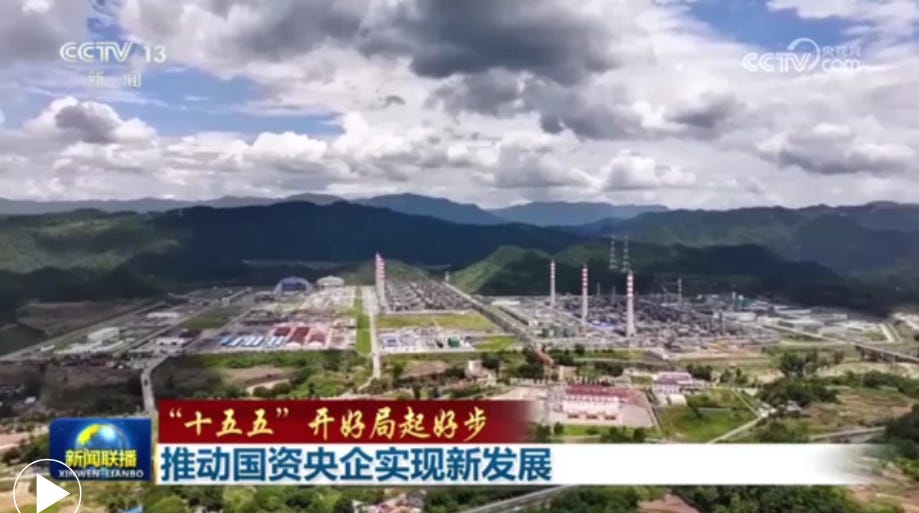
The 15th Five-Year Plan has emphasized the new critical role of SOEs in advancing the Party’s goal for China’s tech development and modernization. The government is not only focused on expanding the scale of SOEs, but has appointed them as the driver of “new quality productive forces” (新质生产力), a concept introduced by Xi Jinping referring to economic growth based on cutting-edge technology, innovation and industrial development, including key emerging sectors, green transition and tech self-reliance. In this way, SOEs become the government champions in carrying out the Party’s macroeconomic plans and directives, while committing to national security, disaster relief and social stability.
On this matter, Xi Jinping emphasized that “on the new journey, central enterprises must fully recognize the responsibilities and mission they shoulder, better serve the overall interests of the Party and the state, serve the high-quality development of the economy and society, serve to guarantee and improve people’s livelihoods, bravely carry social responsibilities, contribute greater power to the construction of Chinese modernization. They must focus on their primary duties and core businesses, continuously optimize the layout of the state-owned economy, coordinate development and security, effectively prevent and resolve risks, and constantly consolidate the foundation for the safe development of enterprises” (新征程上,中央企业要充分认识肩负的职责使命,更好服务党和国家工作大局,服务经济社会高质量发展,服务保障和改善民生,勇担社会责任,为中国式现代化建设贡献更大力量。要聚焦主责主业,持续优化国有经济布局,要统筹发展和安全,有效防范化解风险,不断夯实企业安全发展的基础).
According to Dr. Alicia García-Herrero, Chief Economist for Asia Pacific at Natixis and Senior Fellow at Bruegel, the main strength of China’s state-owned economy is “the ability to mobilise capital at scale and over long horizons toward strategic goals. That is how China built world-class positions in EVs, batteries, solar and high-speed rail far faster than markets alone would have.” At the same time, “its biggest weakness is capital misallocation. Credit flows to politically favoured sectors and firms rather than the most productive ones, so returns on assets keep falling, SOEs earn markedly less than private firms, and debt rises faster than output. The model is good at building capacity and poor at knowing when to stop.”
Domestic Consumption Imbalance
On a domestic level, China presents a significant imbalance when it comes to industrialization and consumption. “Household consumption at around 40% of GDP, with investment of similar size, is unbalanced by any international standard,” commented Dr. García-Herrero. The 2025 trade surplus record of around $1.2 trillion clearly displays the excess of China’s industrial capacity compared to domestic absorption and imports. Indeed, the country’s low domestic consumption has been the result of a variety of factors, from a heavy infrastructure-oriented growth, investments in industrial manufacturing and government incentives to SOEs to a weak social safety net.
Fixing this imbalance would mean for the Chinese government to make substantial structural reforms to reverse the trend on export reliance to redirect the wealth to Chinese households, thus allowing families to buy what is produced. However, as the HIG China expert Casper Wits explained, “Xi Jinping has a little bit of an old fashioned view of what is important. He sees industrial modernisation as the absolute priority and centre of China’s national security. As a consequence, while social welfare and boosting consumption is not ignored, it’s hardly a part of the core national security.” Because of the government neglect of social services, citizens save more than they spend in order to be able to insure themselves against unexpected economic, health, and social events. When asked whether the CCP is strategically refraining from enhancing household consumption to avoid democratization, Dr. Wits argued that “the fear is real. The Chinese have seen this happen in South Korea and Taiwan, for example. And that was also the expectation of the West that this would happen in China: as people become more comfortable and socially secure, they start asking for other freedoms.” The neglect of social services and the fear of democratisation suggest that the situation is unlikely to change trajectory in the near future.
Asymmetric Competition in the Global Economy
On an international level, China’s state-backed economic model creates friction in the global industry. State incentives allow Chinese companies to lose profit in the short term for long term benefits. However, market oriented Western companies must profit in the short term to survive, thus failing to compete against the Chinese SOEs. “Subsidised credit, cheap land and inputs, and soft budget constraints let Chinese producers undercut competitors in steel, aluminium, solar, EVs and, increasingly, legacy chips and machinery,” explained Dr. García-Herrero. As a result, China’s overcapacity keeps creating global trade frictions while fueling the fear of deindustrialization, threatening to hollow out other countries’ industrial capacity by absorbing and replacing them with Chinese supply chains.
When reflecting on the long-term sustainability of this system, Dr. García-Herrero stated that “In the short term it is affordable. The state controls the banks, savings are captive, and debt is mostly domestic and in renminbi. In the long term it is not sustainable. Persistent losses become non-performing loans, local government balance sheets erode and deflation (producer prices have fallen since late 2022) squeezes margins across the whole economy. The cost does not show up as a crisis. It shows up as slower productivity growth and a gradual Japan-style drift. The “anti-involution” campaign shows Beijing recognises the problem, but consolidation runs against local governments’ incentives to protect their own champions.”
Because China is becoming a key actor in green and sustainable technologies, the West should avoid a full decoupling, while striving to cooperate with China in green transition while at the same time restraining China’s offensive tech build up. According to Dr. García-Herrero, this should happen “selectively and from a position of strength.” As she explained, “full decoupling is costly and unrealistic. Unconditional openness is naïve. (...) It should welcome Chinese investment in Europe when it comes with technology transfer, local production and local jobs, which reverses the old joint-venture logic. It should de-risk in critical technologies and inputs, and use trade defence firmly against subsidised overcapacity. The problem is less about whether to engage than whether Europe has the industrial policy and unity to negotiate as an equal.”
Conclusion
The CCP has emphasized the crucial relevance of the 15th Five-Year Plan in carrying forward China’s modernization through the direct attribution of duties and responsibilities to SOEs, positioning them as major drivers of the “new quality productive forces.” Rising geopolitical tensions and risks of ever-present foreign restrictions have steered China towards an innovation and supply chain protection strategy led by SOEs to overcome technological chokeholds. However, this export- and industry-oriented model is challenged by the domestic consumption deficit and trade surplus imbalance, which heightens international concerns on overcapacity. Although the near future will remain dominated by SOEs, China’s state-owned economy faces long-term structural sustainability risks, leaving the door open to new economic policy shifts.
The line from Dr. García-Herrero that the model is "good at building capacity and poor at knowing when to stop" captures the tension well, especially next to household consumption sitting at around 40% of GDP. If SOEs are rewarded for serving the Party's priorities rather than returns, what signal would tell planners that capacity has outrun demand? And does the shift from land-based to equity-based revenue for local governments make that signal weaker or stronger?