

In Summary
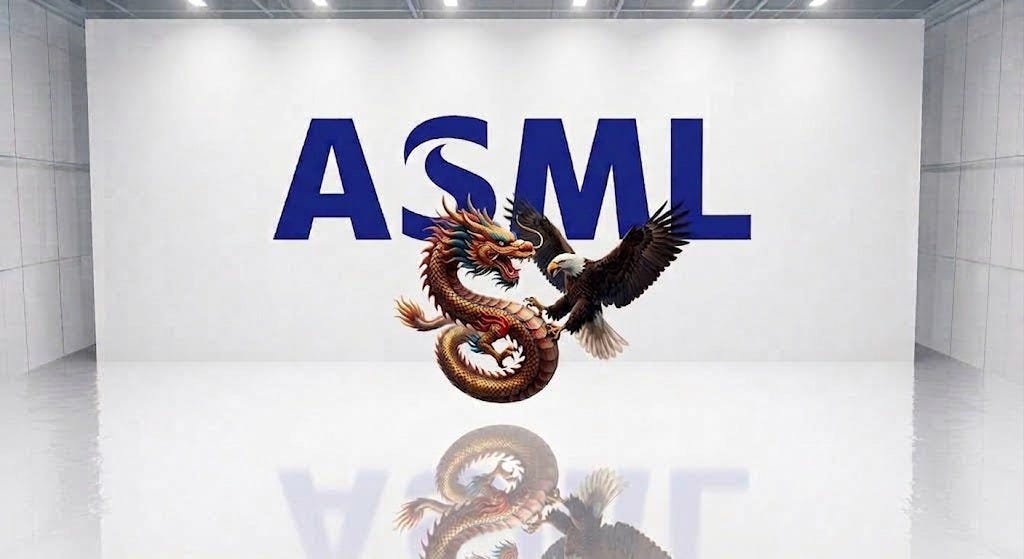
ASML holds a monopoly on the most advanced machine in the world to produce chips, namely, the EUV machine, thus getting caught in the middle of geopolitical tension and competition between the US and China.
The European Union’s fragmentation, competition and underfunding have paved the way for the US to enforce even stricter export restrictions, negatively impacting ASML’s exports to China.
Pax Silica is the US security umbrella, aiming to coordinate and protect the semicon value chain within the allied countries, cutting off China from advanced technologies.
It is not surprising that semiconductors have been called the “new oil.” In today’s world, control over the semiconductor’s supply chain has been significantly impacting geopolitics. Given that chips are nowadays at the foundation of AI, national defence, cutting-edge infrastructure and economic growth, whoever controls the production secures power, growth, influence and security . The US, through export controls and national semicon production, is trying to stop strategic technological assets from reaching countries such as China. On the other hand, China is investing to develop and innovate so as to become self-sufficient. The clash between these superpowers has been affecting many semicon worlds players, such as ASML. As semiconductors become one of the most crucial assets in today’s world, it becomes essential to understand the strategic use, as well as the logic behind export restrictions on China and their direct connection to the US political and security interests.
The Uniqueness of ASML
Through the unique development of their lithography machines, ASML made it possible to further reduce the size of the transistors, the solid-state switch for electric current, succeeding in what was deemed to be impossible. The crucial role the company plays in today’s semiconductor industry is tightly linked to Moore’s Law, the prediction that the possible number of transistors inside chips is going to rapidly increase, doubling every two years. Since Moore’s observation, the number of transistors possible in one chip has gone from tens to tens of billions, proving his vision true. This process had a drastic impact on the power and cost of the chips themselves, which has become so affordable that nowadays chips are integral parts of our everyday life. In smaller transistors the current takes less time to go through the transistor, while at the same time generating less heat, thus making them more powerful. As Diederik Baazil, journalist and author of the book De belangrijkste machine ter wereld (The Most Important Machine in the World), stated, “ASML engineers like to joke ‘ASML’s EUV isn’t rocket science, it is more complicated than that’.”
US Influence on ASML Export Restrictions
Being the company who holds a monopoly on the “most important machine” in the world, brought some geopolitical consequences. As Baazil emphasized, “ASML’s most advanced EUV machine is the biggest chokepoint in China’s technological development as the country isn’t yet able to produce such a machine themselves, and there is no replacement available anywhere. China has access to older generation ASML machines and is able to maximize the use of those, but isn’t able to produce the most advanced chips because it doesn’t have ASML’s EUV. Therefore, ASML is central in American efforts to stall China’s technological advance and we argue it is the most critical pillar of their export regime. NVIDIA is allowed to ship fairly advanced chips to China, ASML won’t get such freedom from the American government because too much is at stake.” Although export restrictions are a prerogative of each country, the US came out with a questionable policy that grants jurisdiction whenever a machine contains any US product.
“ASML’s executives have often voiced that they believe restrictions will work counterproductive, as the tech sector relies on a global ecosystem. Hence they have objected to restrictions. My impression is that they start to realize that a world without these restrictions is now unlikely, and in such a world you want a strong shield from the government. The Netherlands is too small to provide this, hence more EU coordination on these measures is desired.” Baazil specified. However, as long as the European member states do not give up their national power, the EU will not be able to act as a single unified entity. This is exactly why it is the Dutch prime minister, and not Ursula von der Leyen, who gets invited to the White House to discuss about ASML. Taking advantage of the EU’s weak position, the US has been working on the MATCH Act proposal, aimed at closing off China from advanced DUV technology in order to protect the US technology and national security interests. While the Match Act is still a proposal, its measures are already being put into practice, further limiting the autonomy of ASML and other semicon companies while dangerously overstepping European technological sovereignty. On behalf of the Dutch government, the Minister for Foreign Trade and Development Cooperation, S.W. Sjoerdsma has expressed his opposition to the MATCH Act, arguing that every country should be able to decide for themselves regarding the necessary export controls to apply, firmly opposing the extraterritoriality of US legislation and their unilateral measures for the companies who fail to comply with the new regulations.
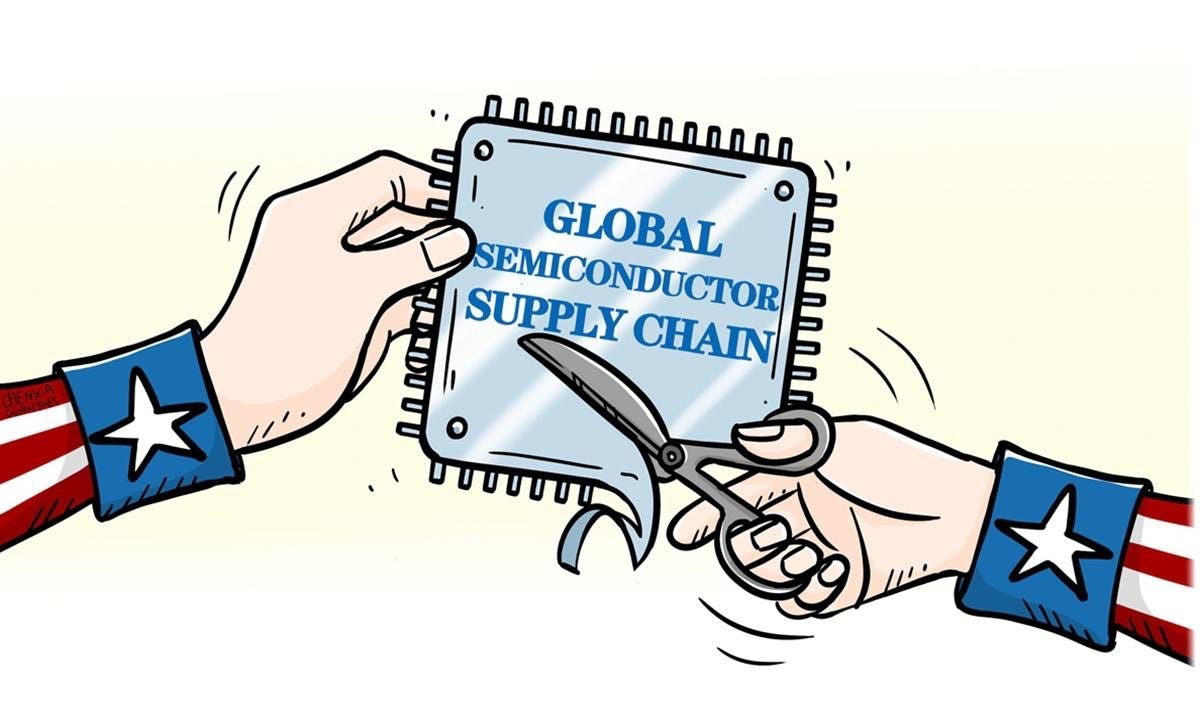
“US CHIPS Act Serves No One.” Editorial Cartoon. China-US Focus, August 15, 2022. Chen Xia.
The US Security Umbrella Against China
In 2025, the US launched the Pax Silica, a “strategic initiative” with the allied countries to ensure the security and development of the silicon supply chain, ranging from critical raw materials to semiconductors and advanced infrastructure. Pax Silica is the new US geopolitical strategy to secure control over the critical bottlenecks across the AI technology stack, such as ASML in the Netherlands, cutting off China from advanced technologies.
If there is one common ground between Democrats and Republicans in the US, it is viewing China as their main competitor. While on the one hand the US takes extreme positions on China, on the other hand Europe has been slow to adjust to China. If it was not for the imposed export restrictions, ASML, as a profit-oriented company, would freely export its machines to China. However, HIG China expert Casper Wits warns from the danger of underestimating China, stating that the Chinese government is “very obsessed with dominating future technologies. (...) If we give them the most advanced machines, they’re going to be used in every type of industry, including the military industry, which means that advanced weaponry with the most advanced chips will be used in a war against Taiwan as well.” Some published reports have been talking about China having already developed their own immersion DUV machines. These reports, although still not verified, give a powerful message, emphasized by Dr. Wits: “the reality for us is that China is in many ways progressing in all those areas at lightning speed. It’s quite scary for us.” The reason behind China’s goal of dominating the fourth revolution lies in the fact that, as Dr. Wits outlined, “that would sort of solve all their economic problems because it would lead to some sort of economic dominance in future economies. Whether that’s realistic or not is quite questionable.”
The US has been exercising more authority over ASML export restrictions due to considerable fragmentation within the EU. As restrictions have been undermining the value chain, Pax Silica was launched to act as an umbrella to protect the US semicon value chain. While US restrictions provide short-term benefits, they also force China to innovate and push for self-sufficiency. As Baazil perfectly concludes: “personally I don’t believe China needs any push in the back to strive for technological autonomy. They have done so for years in every important tech sector, export controls or not. (...) Despite the controls China is still able to produce quite advanced chips, which is an achievement and testimony to its skill.”
